


Dear Open to Work: A personal letter about transferable skills, questioning my value, and exploring where twelve years of experience could take me.
“Have you ever thought about data centers?” A friend asked me that as we talked about what I might do after leaving my last employer. I hadn’t. After twelve years largely in healthcare planning, design, and construction, I wanted a change of sector. I wanted to return to projects measured in billions, feel challenged by their complexity, and be excited about what I would have to learn. Data center construction hadn’t occurred to me yet.
I wanted those twelve years to come with me, though. Too much was in them to leave behind: the judgment, the difficult conversations, the decisions whose consequences taught me to ask better questions next time. I was ready for a different environment, but I was trying to understand where everything I had learned would fit.

“Brea, you have a very adaptable mind. I can see you succeeding there. Let me send your résumé to the team.”
Naturally, I explained why this might not work. I had never delivered a hyperscale data center. My exposure had been limited, certainly nothing I would call substantial experience in the sector. I didn’t yet understand the systems, technical requirements, and ways of working. He encouraged me to send the résumé anyway. He said the team was also interested in skill set and personality. Let them have the conversation. Within a week of that introduction, I had a job offer.
I am grateful for how quickly it happened, and careful about what I make of it. Some of you have been searching for months. You have contacted people, revised your résumé, widened your search, and tried to remain hopeful through conversations that led nowhere. You may be doing all of that while quietly calculating how much longer you can afford to wait. My experience doesn’t mean you missed an obvious step. I would never want my good news to become another reason someone else questions themselves. What stayed with me was the moment before the offer, when my friend saw somewhere I could belong while I was still explaining why I might not.
Recognizing My Transferable Skills
I looked at my experience through the sector where I earned it. Healthcare was familiar. I understood its competing priorities and the work required to connect planning, design, construction, and operations. I knew how a seemingly small decision could travel through a project and arrive months later as a budget problem, a delay, or something the people operating the building would have to live with.
Much of that work required me to coordinate people whose responsibilities overlapped but didn’t necessarily align. A design decision could affect equipment procurement. A procurement delay could change construction sequencing. A completion date could look perfectly reasonable until someone examined everything that needed to happen before the facility could open. I learned to look for those connections and ask what a decision would mean beyond the meeting where it was made.
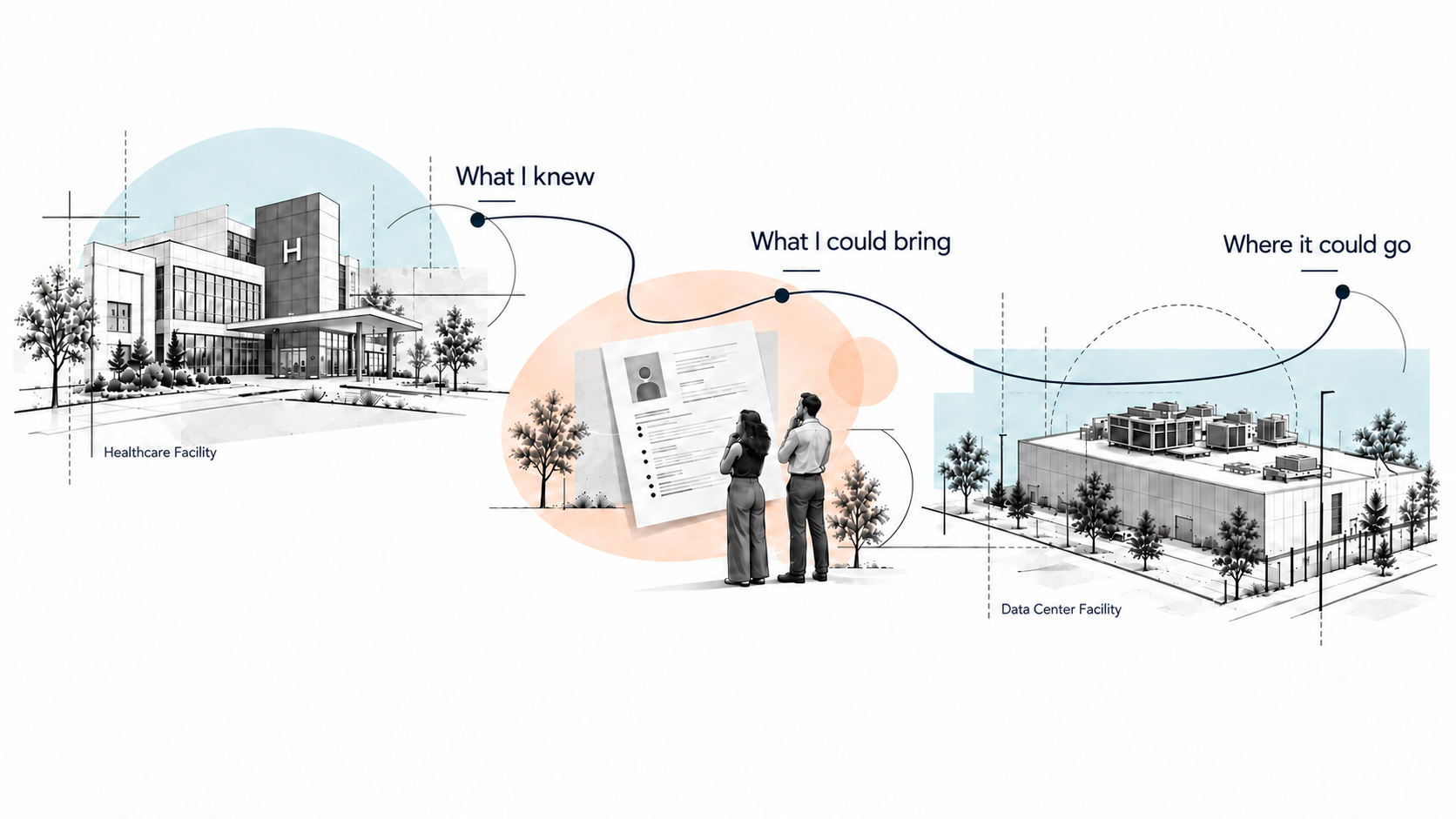
When I considered moving from healthcare to data center construction, however, my attention went straight to what I did not know. The unfamiliar parts became so prominent that everything I could contribute began to recede. My friend knew how I thought. He had seen enough of me to believe I could learn, adapt, and be useful in a different setting. He was willing to put my name in front of a team, and his confidence gave me enough room to consider the possibility before dismissing it. I spend much of my professional life asking people to examine assumptions. Apparently, I needed someone to help me examine this one.
A Career Change Can Begin With a Conversation
I had also assumed that changing sectors would mean accepting less compensation. Without direct experience delivering a hyperscale data center, I expected a financial concession in exchange for the opportunity to learn. Before anyone had made an offer, I had already negotiated myself downward. I had managed to become both the candidate and the person arguing against her salary.
The total compensation package turned out to be worth more than my previous one. I was grateful, of course, but also taken aback by how readily I had discounted twelve years of experience. I had been treating what I needed to learn as though it reduced the value of everything I already knew. The team could assess it for itself. I needed to give them the chance. That offer does not tell me what another employer would pay someone changing industries. It does tell me that my assumption about my own value was incomplete. I had considered my lack of sector experience but didn’t give equal attention to the judgment and delivery experience I could bring.
There will be a learning curve, and I am looking forward to it. Healthcare facilities and data centers serve different purposes and have different technical requirements and operating environments. Experience in one does not automatically provide expertise in the other. I need to understand the systems, project expectations, and decisions that matter in this setting. But I can enter that learning process with a foundation. I can be experienced and still be new to something. I am beginning to appreciate how much possibility there is in allowing both to be true.
A Career Change Can Begin With a Conversation
I am grateful that I talked about what I was considering before I had a clear answer. Those conversations gave people a chance to suggest possibilities I would not have found on my own. One friend’s introduction became an opportunity because I was willing to let the team decide whether my experience belonged there.
So, dear Open to Work team, I offer this experience with gratitude. Being open with friends and leaning on my network made a difference. So did being willing to consider work I hadn’t previously imagined. I thank God for the opportunity and for the people who helped me recognize it.
If you are thinking about a career change, it may help to tell people more than the title you are seeking. Tell them what you want to work on, what interests you, and what kind of challenge would make you feel engaged again. Give them examples of what you have learned to do well. Someone who knows your work may recognize a place for it that you have not considered.
For me, that meant looking beyond healthcare at the work I had been doing within it. Coordinating complex teams, understanding how cost and schedule influence decisions, anticipating dependencies and connecting construction delivery to operational readiness were all part of my experience. I needed to explain those abilities clearly enough for someone in another sector to assess their relevance.
And if you’ve been having those conversations for months, I hope someone stays attentive. I hope they remember you when an opportunity comes into view. I hope you have people you can be honest with about the waiting, without having to make every conversation sound optimistic. A job search asks you to explain your value repeatedly. That can become tiring even when you know exactly what you bring.
I’ve never worked on delivering a hyperscale data center, but I am bringing twelve years of experience to that work, along with plenty of curiosity and much to learn. For those still searching, I hope someone sees your experience with the generosity and imagination my friend brought to mine. There may be a place for what you have built that you cannot yet picture. I couldn’t either, until someone asked me a question.
With gratitude